
Improv Is Not Funny
At least, not to the characters.

My favorite improv scenes are hilarious to watch, but the people in them are not trying to be funny. They’re just living their lives. They care about things. They’re reacting honestly. And from the audience’s perspective, it’s… funny.
Think about your favorite comedic characters from movies and TV. Michael Scott. Leslie Knope. Tracy Jordan. Moira Rose. Lucille Ricardo. Homer Simpson. The brothers from Step Brothers. None of them think they’re funny. They’re not telling jokes (“That’s what she said” excluded). They’re trying to succeed, to be loved, to protect their pride, to get what they want. The comedy comes from how sincerely they pursue those things.
Lucy does not stuff all those chocolates in her mouth and in her blouse and hat because she thinks it’s funny. She’s doing it because in her state of panic, it’s her best idea to fix the problem of a conveyor belt that keeps getting faster and faster.
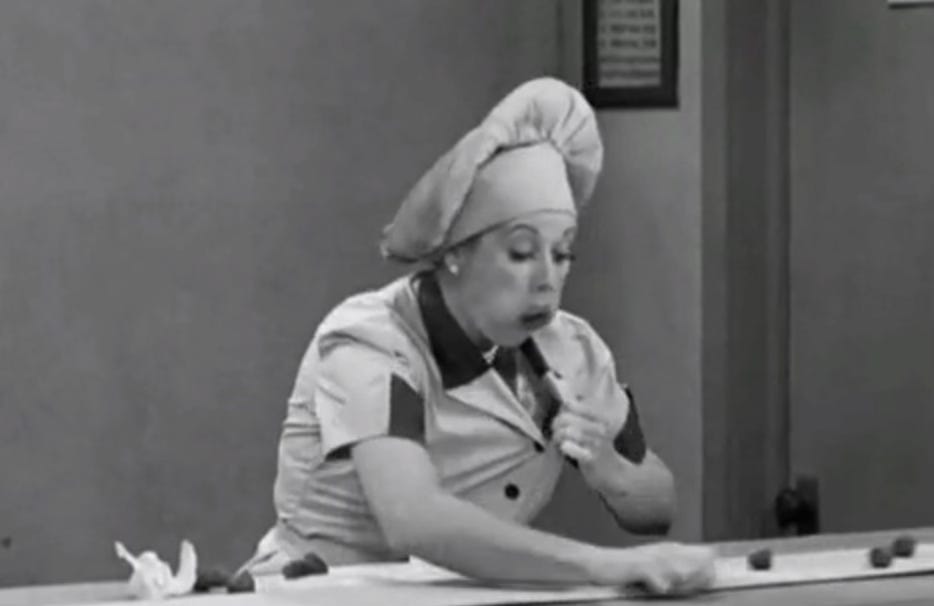
The audience laughs because they see the gap between how the character sees themselves and how the world sees them. But inside the character’s head, everything makes sense. That’s the same engine that drives good improv.
Humans make choices out of care. We care about our relationships, our pride, our comfort, our fears. We chase things we want and go to pretty great lengths to avoid things we don’t. Most of the time, emotion makes the choice first and logic shows up later to explain it.
You’ve probably felt it:
“I wish I hadn’t said that.”
“I’m 37 and just ate a third bowl of ice cream. Why?”
“I should call my ex.”
Emotion drives action. And action is what makes scenes come alive. You’ve probably been in scenes where two characters meet center stage and just… talk. Everyone is polite. They talk about doing some stuff. But nobody cares enough to do anything.
But imagine you and I are sitting at a breakfast table and you steal my last piece of bacon while staring me dead in the eye. I can make a choice to care about that, sincerely. Maybe I get mad and drink the rest of your juice out of spite. Now, something is moving. We have reactions, consequences, momentum.
This is technically “plot.” We don’t have to invent it.
Plot shows up when characters care and act on their feelings. One action causes another, and the scene starts moving on its own (cause and effect). This is where improvisers sometimes get in their own way.
An improviser is always operating on two levels: what the performer knows and what the character knows. The performer might see absurdity or comedic opportunity, but the character doesn’t. The character only knows they care about something (hopefully something their scene partner just did), and they react accordingly.
The moment we leave that and start trying to manufacture funny stuff, scenes get thinner. We stop reacting and start inventing. We miss what our partner is offering because we’re busy searching our own heads for jokes.
I have way more fun when I’m not trying to be funny and instead just responding honestly to what’s happening. Sometimes I don’t even know why my character feels something yet.
“You moving that chair makes me mad.”
“You bringing in groceries makes me sad.”
The reason will come later. The feeling is enough to make a choice and trust that my scene partner will make another to move the scene forward.
Ashley said that this section bears deeper exploration, and I agree, so I’m putting brackets around these few sentences to dive deeper into the subject in a future article. Ok, back to the article at hand.
I tell my students all the time not to go for laughs. And yes, improv is mostly comedic, and audiences want to laugh. A funny line popping into your head isn’t a crime. If it makes sense for the scene, say it! The problem is that the desire to get laughs is powerful. Without the compass of taking care of your partner and the scene, it’s easy to abandon sincerity for a quick joke. Someone fires off a quick pun, the audience politely chuckles, and suddenly the scene’s internal logic collapses. Then you’re left standing there thinking “Please, for the love of god someone edit and get me the hell out of here.”
When I see that happen, I don’t see a bold comedic choice. I see panic. I see someone reaching for control or validation, turning inward to invent instead of outward to discover with their partner. And look, I’m not immune to breaking onstage. Watching someone genuinely laugh at a discovery is one of my favorite things in improv. That laughter usually means something real and genuinely surprising just happened.
But the best shows I’ve been part of happen when I stop worrying about being funny and take my partner and the moment seriously. Scenes open up. Choices become obvious. Playing feels effortless. And funny and interesting things still happen. It’s just happening to the audience, not to the characters.
You take the scene seriously. The audience will take care of the laughter.
I think this distinction about what the performer knows vs what the character knows is gold. "[Characters are]... trying to succeed, to be loved, to protect their pride, to get what they want. The comedy comes from how sincerely they pursue those things." As a total nerd off-stage, I'm reminded of what being a nerd really is... caring a lot about something... maybe too much. Note to self: Bring nerd energy to characters, so we all can have a laugh at the sincerity!